












Following is the text of comments at the opening of the 2022 Vienna Conference on the Humanitarian Impact of Nuclear Weapons on June 20, 2022, by John Polanyi, Professor of Chemistry at the University of Toronto, awarded the Nobel Prize in Chemistry in 1986.
VIENNA (IDN) — Ambassador Alexander Kmentt, convener of the 2022 Vienna Conference on the Humanitarian Impact of Nuclear Weapons, has invited me today to give a brief reminiscence of the birth of our nuclear age. Unsurprisingly, given my profession, that birth date roughly coincides with mine. What my remarks will illustrate is the speed of today’s change, as well as the responsibility of scientists for it. [2022-06-20]

< John Polanyi. Credit: Johnny Guatto
With 20m killed in WW1 and 60m in WW2, mankind showed it could mass-produce death. Then A-bombs increased the power of weaponry a thousand-fold, H-bombs by a million-fold. The world took note and in a bold move reduced the number of these weapons to a few thousand.
That is the good news. The bad news is that this residue can destroy civilizations.
How did this new world come into being? It owes its existence to the power of modern science.
But that is also good news since it testifies to the ability of a worldwide international community to cooperate while competing fiercely.
For science is highly competitive, while being supremely cooperative. Rarely today does a scientific paper have a single author. And when it does, the list of references makes clear its indebtedness to others.
Isaac Newton’s claim to be standing on the shoulders of giants was genuine. Science shows the ability of competitors to share.
Applied to the world at large, that would be transformative.
But how do we combine competition with collaboration? This happens in societies linked by trust. Only occasionally can scientists stop to verify others’ findings. For the most part, they believe their colleagues.
The success of science shows that this trust is well-placed. The moral obligation to speak the truth, applies rigorously to science. We make the penalty for falsehood severe; it is life-long banishment from science. Not only do you lose your livelihood, you lose your friends.
The trust that exists between colleagues carries an important message; we are all valid observers. Testament to this came from the acceptance of Albert Einstein, a stateless patent clerk, as having the right to challenge science’s highest authorities. This affirmed the most fundamental of human rights; the right to be heard.
Tyrannies hold to a different ethic. For them, the truth takes second place to utility. Accordingly, they prove inhospitable to science.
A century ago, German science reigned supreme. But within a decade the Nazis had destroyed it. Characteristically, the science they put in its place was spurious—racial purity. Communism’s false science was that of unending class struggle. Societies that elevate doctrine over truth, soon lose sight of the truth.
That is why there is fear today of China. The fear extends to the possibility that it might blunder into war over Taiwan. President Biden stated that U.S. support for Taiwan is “rock solid”. But so too, is President Xi’s claim to own Taiwan
Where will the world shelter if these nuclear powers come to blows?
The contending parties are bound by the UN Charter, making aggression a crime. In 1945, following two world wars and the Nuremberg trials, the world demanded an end to ‘might as the arbiter of right’.
They did so because might is bereft of reason. It lacks validity. Reason gave us science, laws of nature, and some laws of man. From these laws came courts, where laws can be argued. There is a profound difference between that, and the rule of the gun.
To set the gun aside will, however, require an act of will, opposing the continual call for armaments. The rationale for arming is that others do it. This defies logic, since it is a race to no visible destination except war. And that we can no longer tolerate.
A turning away from war is evidenced by the decline in inter-state violence over the past three-quarters of a century. Objectively, peace seemed to be winning —until Russia’s invasion of Ukraine.
This meeting contemplates the terrible consequences of nuclear war, from which we have been saved for seventy years by no more than a notional ‘taboo’. However, the legislation exists to transform that taboo into law. It is the UN Treaty on the Prohibition of Nuclear Weapons, endorsed by 122 states, which will be the topic over the coming days.
The outlawing of slaughter has been proposed before, then laughed at. “Not so fast” the proponents were told. But soon they found that the “little by little” they were being offered, meant never. They needed to make a break with the past.
One such break ended the burning of heretics, another ended murders sanctioned as duels, a third ended torture en route to slavery.
Then, as now, humanity cried out for change. Together, we can make this such a moment. [IDN-InDepthNews – 20 June 2022]
* John Polanyi is a Member of the Privy Council for Canada, a Companion of the Order of Canada, and has been awarded over thirty honorary degrees from six countries. He has served on the Prime Minister of Canada's Advisory Board on Science and Technology, Foreign Honorary Advisor to the Institute for Molecular Sciences, Japan, and as Honorary Advisor to the Max Planck Institute for Quantum Optics, Germany, among other appointments.
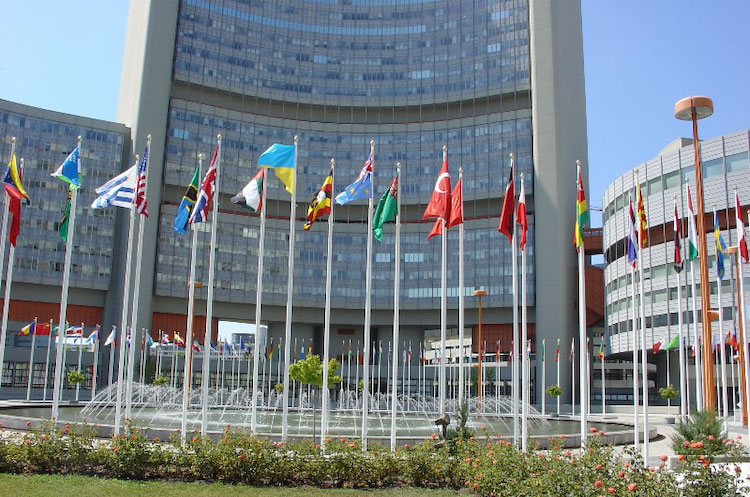
Image: The Vienna International Centre. Credit: Research Gate.