











By Jaya Ramachandran
GENEVA (IDN) — The Basel Peace Office, in cooperation with other civil society organisations, has challenged the nuclear weapons policies of Japan and South Korea in the UN Human Rights Council, maintaining that these violate the Right to Life, a right enshrined in Article 6 of the International Covenant on Civil and Political Rights (ICCPR). [2022-07-31-10] GERMAN | JAPANESE TEXT VERSION PDF | KOREAN
The two East Asian countries' nuclear strategies have been called into question in reports submitted on July 14 as part of the Universal Periodic Review (UPR) of the obligations of Japan, South Korea and 12 other countries under human rights treaties. (See Submission on Japan and Submission on South Korea).
The submissions, presented at a time when Russia has made nuclear threats to the US and NATO if they intervene in the Russian invasion of Ukraine, underline the need to address the risks of nuclear deterrence policies. Besides, Russia is not the only country that possesses nuclear weapons and/or maintains options to initiate nuclear war.
"In times of high tensions involving nuclear-armed and/or allied states, plans and preparations for the use of nuclear weapons elevate the risk of nuclear war, which would be a humanitarian catastrophe, severely violating the rights of current and future generations," says Alyn Ware, Director of the Basel Peace Office. "Compliance with the Right to Life with respect to nuclear weapons is, therefore, an urgent matter, impacting the rights of all humanity."
In 2018 the UN Human Rights Committee affirmed that the threat or use of nuclear weapons is incompatible with the Right to Life, and that States parties to the ICCPR have obligations to refrain from developing, acquiring, stockpiling and using them. They must also destroy existing stockpiles and pursue negotiations in good faith to achieve global nuclear disarmament.
But both Japan and South Korea are engaged in extended nuclear deterrence policies which involve the threat or use of US nuclear weapons on their behalf in an armed conflict. Both have also supported the option of first use of nuclear weapons on their behalf, even when the United States has been trying to step back from such a policy.
The Basel Peace Office and other civil society organisations argue that the extended nuclear deterrence policies of Japan and South Korea violate their human rights obligations, as is their lack of support for negotiations for comprehensive, global nuclear disarmament.
The submissions make several recommendations of policies the governments could take to conform to the Right to Life. These include adopting no-first-use policies and taking measures to phase out the role of nuclear weapons in their security doctrines.
This they could do by establishing a Northeast Asia Nuclear-Weapon-Free Zone and urging at the ongoing Non-Proliferation Treaty (NPT) Review Conference an agreement on the global elimination of nuclear weapons by 2045, the 75th anniversary of the NPT.
The submissions are not solely critical of the two governments. They also applaud Japan and South Korea for the positive steps taken. South Kora, in particular, has deployed sports diplomacy (the 2018 Winter Olympics peace initiative) and other diplomatic efforts to rebuild dialogue and agreement with North Korea on a process for peace and denuclearization of the Korean Peninsula.
If the UN Human Rights Council decides to pick up on the challenges and recommendations in the submissions, and direct these to Japan and South Korea, the two countries are required to respond.
Similar submissions were made over the past two years to the Human Rights Council and other UN human rights bodies with regard to the nuclear policies of Russia, the USA, France, Canada, Denmark, Iceland, North Korea, Netherlands and the United Kingdom (see Nuclear weapons and the UN human rights bodies).
At that time, the issues were not taken up in earnest by the relevant bodies. However, it is hoped that the increased threat of nuclear war arising from the Ukraine conflict might stimulate the Human Rights Council to make this a much higher priority for the current review cycles. [IDN-InDepthNews — 31 July 2022]
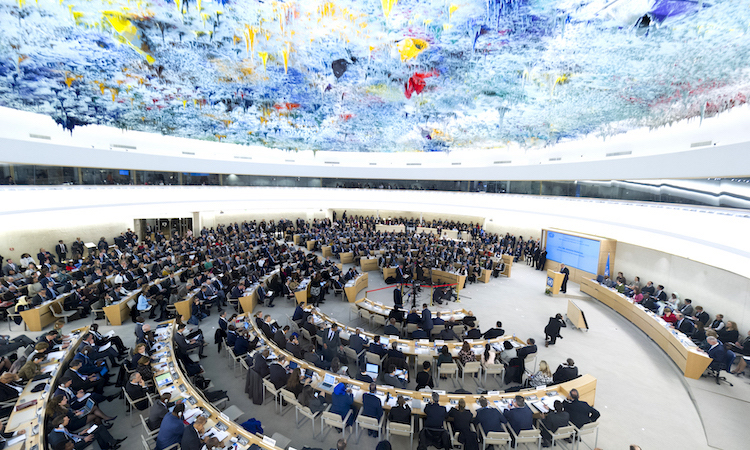
Photo: UN Human Rights Council. Credit: UN Web TV